



In my head everything made sense. I knew where to go, what to do, how to behave like a normal person who belongs there. I had already played through every possible scenario.
And still, nothing could have prepared me for this. Except a LAN party maybe, to be fair.
If you are not from Germany, Cologne is one of those cities known for a cathedral called the Kölner Dom, a river called the Rhine, Karneval (Carnival), and a specific type of beer called Kölsch that people feel very strongly about. Some even call it Köllefornia, a nickname borrowed from California, because people here like to believe the vibe, and occasionally even the weather, is just a little bit warmer than in the rest of Germany.
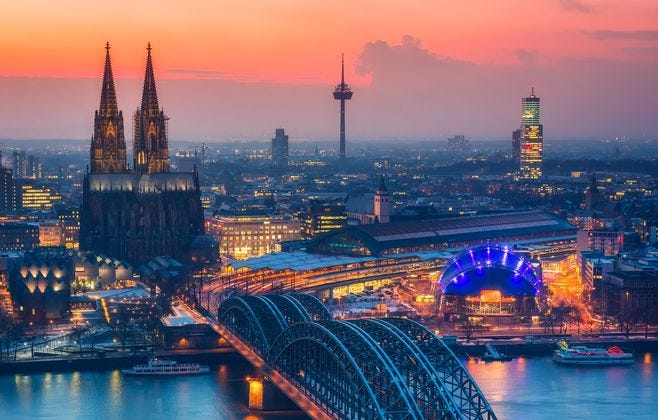
Before I even get into what happened, we need to talk about Gamescom for a second. Because even if you live in Cologne, it still feels slightly unreal. Every year hundreds of thousands of people show up to care very deeply about things a lot of people barely understand. It is one of the biggest gaming events in the world and for a few days the entire city just quietly accepts that this is now the main storyline.
If you are wondering why it’s called Gamescom, not GamesCon, I got you: It is actually a legal and slightly political situation. The predecessor was the Games Convention, which ran in Leipzig from 2002 to 2008 and was organized by the German games industry association (BIU). When the event kept growing, the organizers decided to move it to Cologne in 2009 for more space and better infrastructure. The problem was that the name Games Convention belonged to the Leipzig trade fair. So they were not allowed to keep it. Leipzig held onto the name and even continued running a version of the event from 2009–2010 under Games Convention Online, focused on online and mobile games, just on a much smaller scale. Cologne, meanwhile, launched what is essentially the same event under a new name.


And then there is the Koelnmesse.
I had been there before for another fair and still somehow learned absolutely nothing from that experience. The Koelnmesse is built like a system that assumes you know what you are doing. West entrance, east entrance, halls connecting in ways that feel theoretical. For someone who cannot orient themselves with a compass or even Google Maps, this is not ideal.

I arrived there, slightly stressed, slightly confused, and somehow immediately lost. It felt like I had entered a side quest I did not agree to. At that point I had mentally attended this event 17 times and yet, the building won.
I was there for a speedrun and charity event for the company I work for. We were streaming live on Twitch. I am not going to go into too much detail there because I am not entirely sure what I can already share, but that is the general idea.
What I can say is that within what felt like five minutes, someone asked us where our gaming equipment was.


Which is a fair question. Except we did not have any.
I have never felt more like a complete beginner in a very specific ecosystem. Everyone around us had their setups perfectly arranged. Screens, keyboards, cables, everything placed with intention. People knew what they were doing. They moved like they had done this a hundred times before.
And we were just there. Existing. Trying to look like we belonged.
At some point Red Bull promo guys started walking through the hall, going from table to table, handing out cans. Very efficient. Very practiced.
That was also the moment I realized that energy drinks are not just drinks in this environment. They are something else. Fuel obviously, but also a kind of social currency.
For a second I genuinely thought about saving mine. Just keeping it. Maybe I would need it later. Maybe it would have value.
The guy opened the can in front of me before handing it over.
So, Plan B: I drank it.
And I have to say, for a brief moment, I felt very special. Almost like a real gamer. Which is not something I expected to feel that day, so I will take it as a win.
What I also didn’t expect was how many people were just sleeping. Everywhere. Folded into chairs like broken office furniture. Perfectly still, surrounded by glowing screens. Some even brought their own inflatable mattresses. It felt familiar in a weird way: Like back in school, when you try to stay awake and fail, or when you bring a tent to wait in a line days before your favorite artist performs.
Just something people used to do before everything moved online.
Because LAN parties have always worked like this. Gaming used to be physical. You had to carry your entire setup across town. Monitors, PCs, cables, snacks, sometimes even extension cords like you were preparing for a small, very specific apocalypse.
They peaked somewhere between the late 90s and early 2010s. Basements, school halls, community centers. Dozens of people sitting shoulder to shoulder, connected through a local network because the internet either wasn’t fast enough yet or simply not the point.
You weren’t logging in. You were showing up.
Games like Counter-Strike, Warcraft III, or Quake weren’t just played, they were experienced collectively. You could hear everything twice: once through your headphones and once again, slightly delayed, from the person next to you yelling at the exact same moment. Trash talk was immediate. Wins felt louder. Losses felt public.
And then there was the overnight part. Sleeping bags under tables. Someone always staying awake. Someone always bringing too much energy drinks. Time worked differently. You measured it in rounds, not hours.


Even now, people talk about LAN parties like they talk about early internet forums or MySpace profiles. Slightly chaotic, deeply personal, and impossible to fully recreate. Not because the technology is gone, but because the context is.
Which is probably why something like this still exists.
It is not just about playing. It is about returning to a version of the internet that still had a room.
The atmosphere here kept shifting constantly. I arrived around noon, and by 3pm the overhead lights cut out, replaced by this ambient, gamer-core glow. There were these moments of intense focus where everything felt quiet and concentrated. And then suddenly it would break. Screaming, interrupted by cheering, interrupted by raging. Also, loud clown horn sounds going off somewhere in the distance. I still do not know where they were coming from, but if anyone has an idea, please enlighten me.
There were also inside jokes happening all the time. You could feel them passing through the room. Everyone reacting except you. I could not fully understand them but I respected them. It felt like walking through a language you almost recognize but cannot speak.
At some point it really clicked for me. This did not feel like an event. It felt like stepping inside a subreddit. Everything made sense to the people who were part of it. Everything had context that I did not have.
The speedrun part of it added another layer to the whole experience. Watching someone play a game as fast as possible does not sound that intense until you see it live. It stops feeling like “just playing” very quickly. It becomes something closer to performance: memory, precision, repetition, and hundreds of tiny optimizations that probably took years to master. Muscle memory at its peak. And then doing all of that in front of a crowd, live, while being streamed, adds its own kind of pressure.
My favorite speedrun was definitely Super Mario World. Somehow, I ended up chatting with a gamer there, and he invited me to co-host his livestream while he played SMW. It was such a random but genuinely fun experience.
There was this very specific energy in the room. Focused and almost electric. People were paying attention in a way you do not see that often. Not casually, but properly invested.
By the second day I was still not part of it, but I was also not completely lost anymore. I started to understand the rhythm a little. When things get loud, when things get quiet, when something important is about to happen.
And then I found something that made immediate sense to me.
A table football tournament.
Finally something familiar.

I have been playing table football since I was a kid. Not in a serious way, but enough to know what I am doing. Usually I have to convince people to play with me. It is rarely something people just agree to immediately.
At Gamescom LAN it was different.
I just walked up to a group of guys and started talking to them. They looked slightly confused at first. Maybe a bit surprised. But they were nice. And they agreed to play.
Which is how I ended up, in the middle of this very specific gaming world, doing the one thing I was actually kind of good at.
I am not trying to brag. But I did not embarrass myself.
That felt important.
I did not leave as a gamer. That was never the point. But I left with a very specific kind of respect for people who care deeply about something like this. People who build entire environments around it and fully commit to it.
At the end, it wasn’t strange at all. It felt warm. Familiar, even. Everyone was exceptionally respectful and supportive.
And I think that is the part that stayed with me the most.
You do not have to belong to something to understand that it matters. Sometimes it is enough to show up, feel completely out of place, drink the energy drink you did not plan to drink, and stay long enough for things to start making sense.
When was the last time you visited a LAN party? Tell me your last LAN memory (or your closest equivalent). I’m collecting them.
Catch you next time,
Paula