



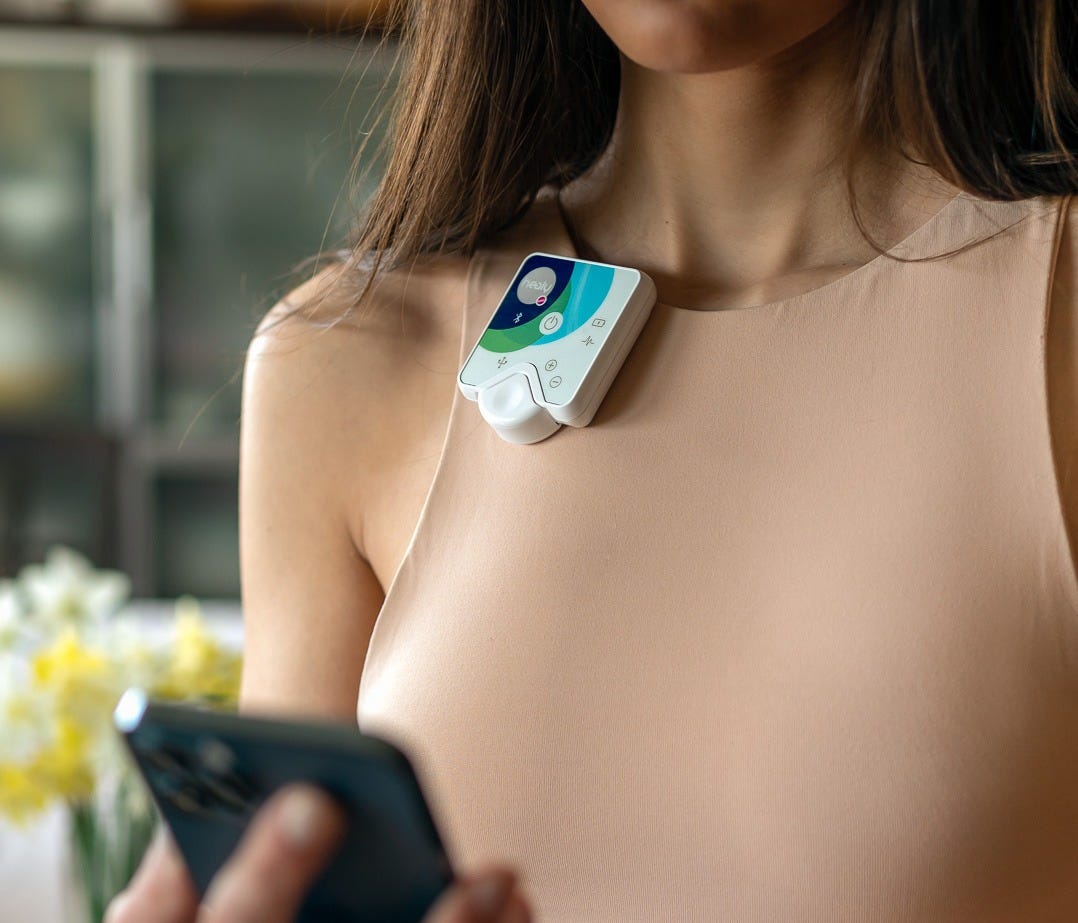
A small wearable device promises to harmonize your “bioenergetic field,” analyze the frequencies of trillions of cells, and help with everything from migraines to depression. It’s called the Healy, and depending on the version, it costs between $500 and $4,000.
On social media, the device is praised as a miracle. Testimonials claim it improves sleep, reduces pain, boosts productivity, and even helps with severe illnesses. There are hundreds of thousands of posts, an army of enthusiastic influencers, and a global network selling the device in more than 50 countries.
But when you look closely, the story becomes far stranger.
A Visionary Founder
The central figure behind the device is Markus Schmieke, a German entrepreneur who presents himself as a visionary thinker bridging science and spirituality.


According to his own narrative, Schmieke was once a concert pianist and chess champion. Later, he supposedly studied physics and philosophy, spent years traveling in India, and lived as a monk for more than a decade. His journey, the story goes, led him to develop revolutionary technologies based on quantum physics and “information fields.”
Isn’t this a fascinating biography?
However, when asked to provide evidence for some of these claims, such as his academic studies or time spent in monasteries, the company was unable to provide any.
What Schmieke has undeniably produced are devices. In 2007, he introduced the TimeWaver, a machine that claims to analyze informational fields and provide therapeutic frequencies. A decade later, he launched his next big idea: The Healy.
The Promise of Frequency Healing
The Healy is a small wearable device controlled by a smartphone app. It comes loaded with dozens of “programs” grouped into categories like work, sleep, beauty, fitness, and emotional balance. Higher-priced versions simply include more of these programs.
The marketing language blends science with mysticism. The premise goes roughly like this:
Every cell in the body has its own electrical voltage.
Illness supposedly disrupts this voltage.
The body also possesses an “information field” containing the frequencies of all its cells.
The Healy analyzes this field and sends individualized microcurrents to restore balance.
Fair enough; the company does not claim the device cures diseases. Instead, it says the device “harmonizes the bioenergetic field,” which may support well-being.
The blurry phrasing is not accidental.
Buried in disclaimers across the company’s website and training materials are statements acknowledging that concepts like information fields, individualized frequency programs, and quantum potentials are not recognized by mainstream medicine and lack scientific evidence.

In other words, the scientific-sounding framework is mainly hypothetical.
Inside the Device
Externally, the device looks well-built. It connects to your smartphone via Bluetooth and sends small electrical currents through electrodes attached to the body.
Inside, the components are surprisingly ordinary: a Bluetooth chip, a microcontroller, a switching circuit, and a battery.
A “quantum sensor” capable of analyzing the body’s frequencies in real time, however, was nowhere to be found.
The only sensor present was a standard infrared diode costing a few cents.
From a scientific perspective, such a component cannot measure the frequencies of trillions of cells or analyze an informational field. Nor could it produce individualized therapeutic signals based on such data.
The device appears to be standard consumer electronics, far from the revolutionary technology described in the marketing.
The Legal Gray Zone
Despite this, the Healy is legally sold in many countries, including the United States and across Europe.
How is that possible?
Part of the answer lies in the regulatory framework for medical devices. In the U.S., some devices can receive authorization if they are considered similar to products already on the market. Microcurrent therapy devices for pain relief already exist, and Healy uses microcurrent as well.
This process does not even require proof that the device works as advertised, only that it is safe and similar to existing products.
European regulations operate similarly. Manufacturers largely compile their own documentation to demonstrate safety and compliance. Independent clinical trials are not always required.

This allows companies to market devices with a medical-looking image even if robust evidence for their effectiveness is simply lacking.
The Real Engine: Multi-Level Marketing
The Healy is not primarily sold through hospitals or pharmacies. Instead, it spreads through multi-level marketing (MLM).
In this system, sellers earn money not only by selling products but also by recruiting other sellers. The more people you bring into the network, the more commissions you can earn from their sales.

The company’s compensation plan contains 17 different ranks and numerous bonuses. At the highest level, top distributors can receive one-time bonuses of up to €500,000.
But income data from the company itself suggests a stark reality. In one year in the United States, roughly 6,000 active sellers participated in the program. Only about 4 percent reached a rank that earned any significant money, and their average annual income was under €2,000.
Meanwhile, a tiny handful of top earners made hundreds of thousands of euros.

This distribution closely resembles the pattern found in many MLM systems: a small group at the top earning large sums while most participants earn little or nothing.
What Happens Behind Closed Doors
The most striking claims about the device rarely appear in official marketing materials. Instead, they emerge in private conversations, group chats, and sales calls.
Salespeople rarely made direct medical promises, but they strongly suggested the device could help with almost any condition: from chronic pain and nerve damage to psychological trauma.
Some claimed it could scan organs, detect vitamin deficiencies, and even send healing frequencies to people thousands of kilometers away.
Others shared anecdotes about people reducing medications or feeling dramatically better after using the device.
These stories feel powerful. They also blur the line between personal belief and medical advice.
Why People Believe
It might be tempting to dismiss all of this as gullibility. But the appeal of devices like the Healy runs deeper than that.
The marketing taps into a powerful cultural intersection: the merging of spirituality, personal empowerment, and scientific language.
Over the past two decades, wellness culture has increasingly adopted ideas drawn from Eastern spirituality, New Age philosophy, and esoteric traditions. Concepts like energy fields, vibrations, and universal consciousness are often presented alongside references to quantum physics and neuroscience.
The result is a narrative that feels both mystical and modern.
For many people, this worldview is deeply appealing. It offers something conventional medicine often cannot: a sense of meaning and personal agency. Instead of being passive patients, individuals become active participants in their own healing journey.
This feels especially powerful for people dealing with chronic illness, long-term pain, or mental health struggles. Medical systems can feel impersonal, slow, and frustrating. When treatments fail or provide limited relief, people naturally start looking elsewhere.
Devices like the Healy promise something radically different: personalized healing based on your unique frequencies.
Technology plays an important symbolic role in making this story believable. A sleek wearable device, a smartphone app, and complex-looking graphs give the impression of precision and sophistication, even if the underlying mechanisms are vague or scientifically unsupported.
Multi-level marketing strengthens this dynamic even further.
Instead of encountering the product through traditional advertising, people often hear about it from friends, family members, or trusted influencers. Personal stories replace clinical evidence. Emotional testimonials replace data.
In that environment, skepticism becomes socially difficult. Questioning the device can feel like questioning the personal experiences of people you trust.
The result is a powerful feedback loop: belief generates stories, stories generate more belief, and communities form around shared hope.
The Vulnerable Customers
Online communities around the device reveal why such claims can be so dangerous.
People ask whether the device can help with multiple sclerosis, opioid withdrawal, diabetes, alcoholism, or severe depression. Some discuss using it for suicidal thoughts. Others share stories about treating cancer or replacing medication.
In many of these spaces, hope circulates faster than skepticism.
For people dealing with chronic pain or serious illness, the promise of a technological miracle can be incredibly seductive, especially when it comes wrapped in scientific language and personal testimonials.
Where the Money Goes
In one recent year, the company reported more than €130 million in global revenue. Yet only a few million remained as profit after expenses.
Why?
Because the highest cost by far is sales commissions. Tens of millions of euros flow back into the MLM network that promotes the product.
A significant portion of each device’s price goes not toward research or manufacturing, but toward paying the people selling it.
Walking the Edge of Legality
Legally, the company appears to operate carefully along the boundary of what is allowed.
Official statements avoid explicit medical claims. Disclaimers emphasize that the device is not intended to diagnose or treat diseases. Responsibility for exaggerated promises is often attributed to individual distributors.
This strategy provides one thing: protection.
But it also allows misleading narratives to flourish, especially in the decentralized world of social media and MLM sales networks.
The Bigger Picture
The Healy is not the first wellness device to promise revolutionary healing through frequencies, energy fields, or quantum physics. Variations of these ideas have circulated for decades.
What makes this case hard to ignore is its scale: a global network, hundreds of thousands of users, and a product that costs thousands of euros despite relatively simple hardware.
For some, the device may function as a placebo, offering a sense of control or hope. But when such products are marketed to people with serious illnesses, the stakes become much higher.
Honestly, if you choose to believe in this, I’m the last person to judge. But before spending hundreds of dollars on a device like this, it might be as effective to listen to the thousands of “frequency healing” tracks freely available on platforms like YouTube. Or maybe just go see a real doctor first.
Catch you next time,
Paula
For context I worked on a social app that created a community for people suffering from chronic illness. A lot of the discussions have ranged on how typical medicine has either failed them or cost far too much for them to continue its use. So I think you hit the nail on the head there with how a lot of these products weave stories of mysticism into their narrative to create a product that very often targets the vulnerable.
Modern medicine isn't always the good guy and in trying to label it the bad guy, we sometimes end up with an alternative badder guy.
It's such a waste when someone spends their time creating gimmicks instead of something truly useful. As if the world has run out of real problems to solve. 😔