



This was all over August:
Apple released recently a stop-motion Mac mini ad, and then released behind-the-scenes footage showing people who are sculpting and painting the elements. It feels like the making-of almost becomes part of the advertisement because audiences now want proof that this was made by humans.
The AI-slop backlash has become strong enough that platforms are introducing different labels, filters and restrictions against generated content.
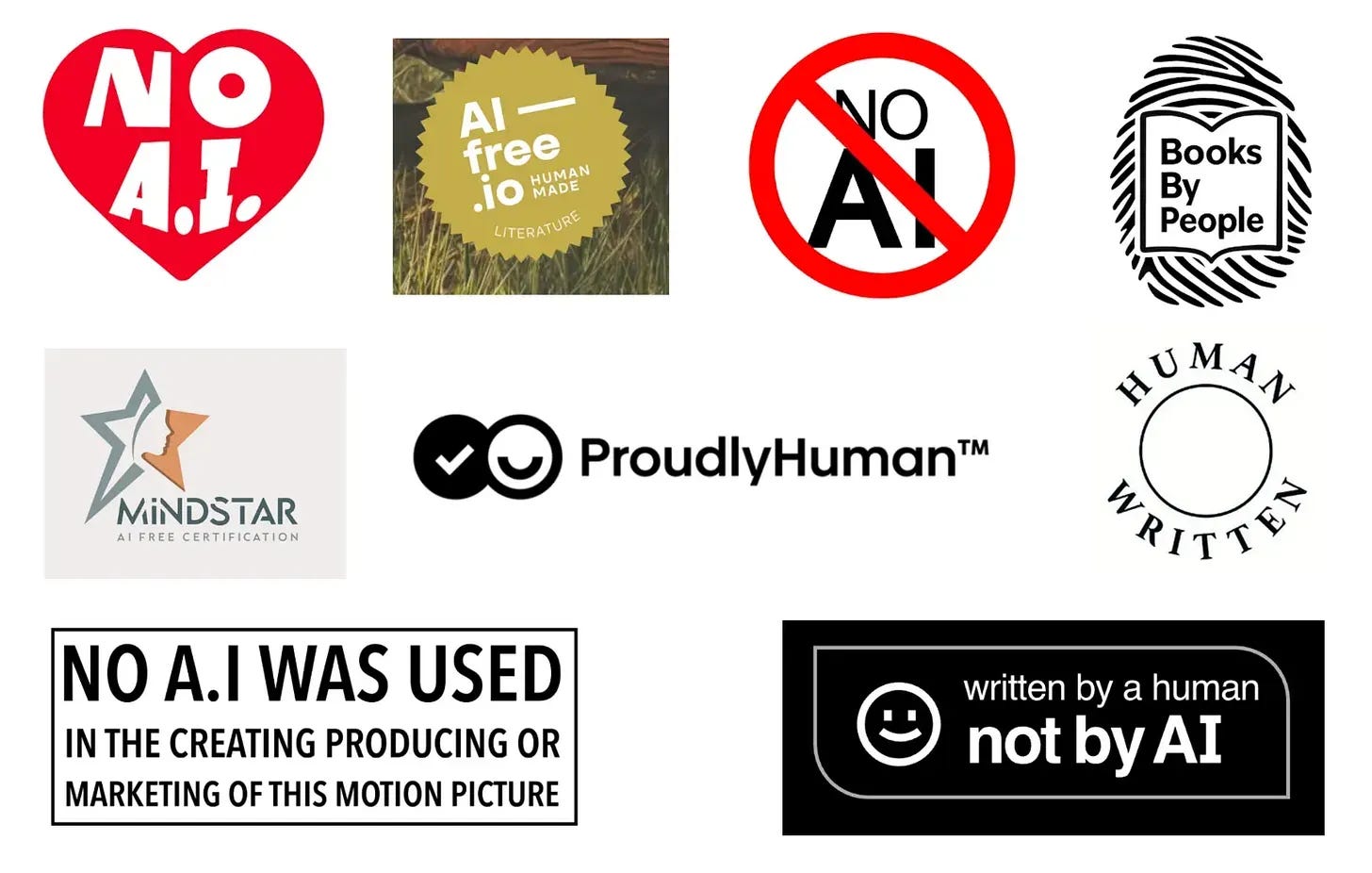
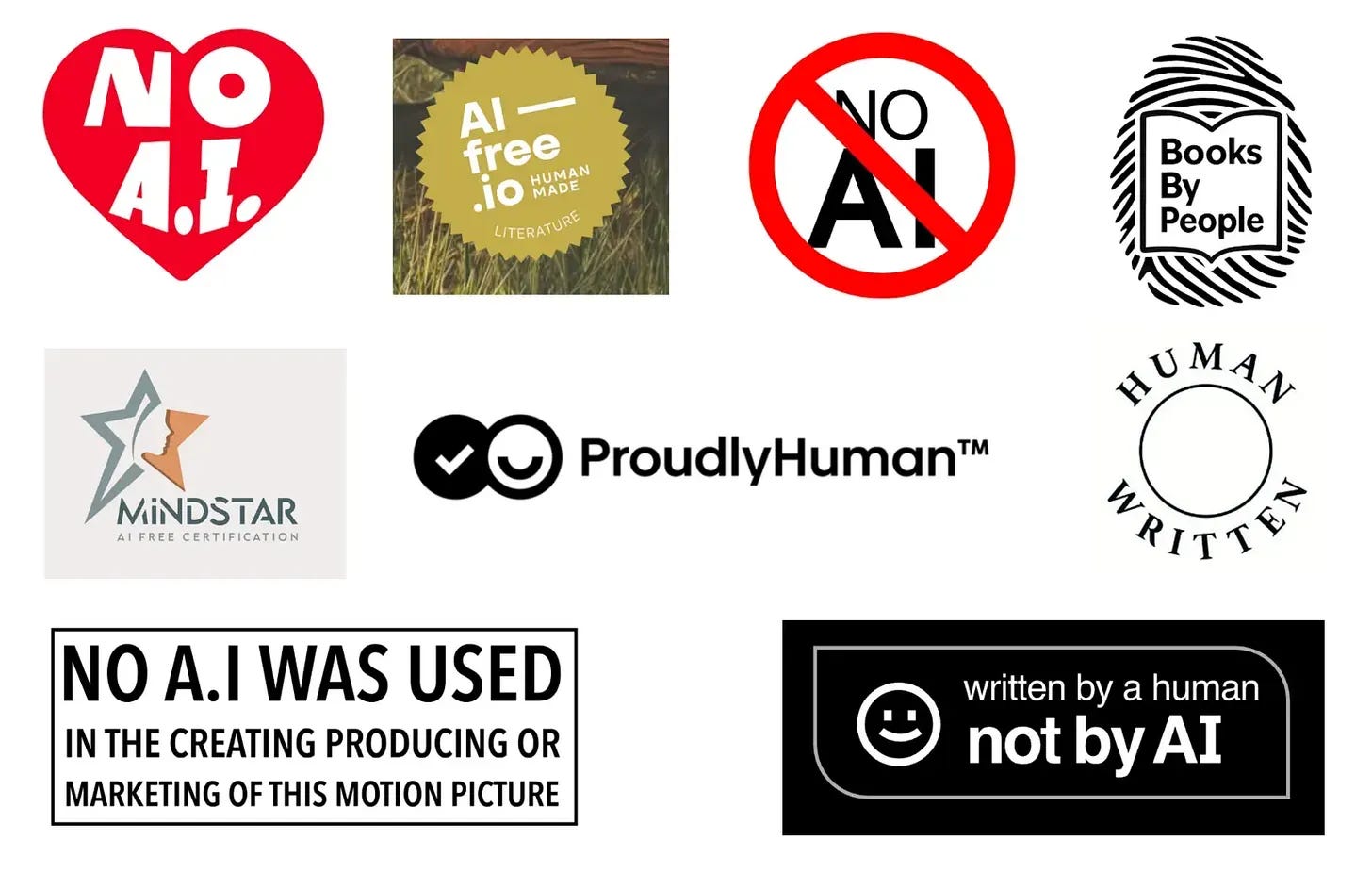
Labels and stamps have been launched by companies and non-profits from the UK, Australia and the US. Source. AI-generated restaurant menus are so bizzare that people are becoming nostalgic for bad amateur Photoshop. There is one in the corner of my house. It's pretty wild.
Low-budget, kinda obviously handmade animation is suddenly being discussed as animation’s “punk rock moment”: technically crude work can feel more culturally alive precisely because it doesn’t look machine-perfect.
The Humankind 2 trailer apparently looked so sufficiently AI-like that the developer had to publicly explain it wasn’t generated. 😵💫
AI accusations are now hitting work that wasn’t made with AI at all. Of course they do. We’re moving from “AI can make anything” to “I no longer know what I’m looking at.”
Even a new advertising-reference platform, The Creatives Room, prominently sells itself as “100% picked by hand, not AI.” Human curation itself is becoming a feature.
BEFORE COMPUTERS MADE EVERYTHING CLEAN
Pre-digital advertising production.
paste-up, Letraset, Rubylith, airbrushing, marker comps, hand lettering, photostat, typesetting
Designers spent decades inventing tools to remove imperfections and mistakes.
Now Photoshop has brushes that recreate them on purpose.


THE ORIGINAL SYNTHETIC IMAGE
Advertising has always manufactured reality. Before Photoshop, commercial illustrators already created impossible:


HUMAN SLOP AND THE STRANGE NEW VALUE OF MAKING THINGS LOOK BAD AGAIN
China’s latest sleeper hit is a film about a cow that looks like somebody opened SketchUp and accidentally found an Export to Cinema button. That is barely an exaggeration: Niu Lai was actually animated in SketchUp, a program intended for architecture, because proper animation software and new hardware were too expensive.
Niu Lai translates roughly to Here Comes the Cow. The cow did come. It just took five years. Director Xin Yumeng made it with his mother, Sun Lifang, using second-hand equipment. She taught herself screenwriting, helped create the animation, wrote the soundtrack and sang the theme song.
Viewer warning: Emotional Roller Coaster ahead:
Beneath the floating cows, Niu Lai is a sincere story about maternal love and the messy work of supporting a child. During its first nine days, Niu Lai sold just 236 tickets and made about 7,169 yuan - barely $1,000. Then the internet found it.
People began buying tickets to confirm that yes, the entire 86-minute film really looks like this. Cinemas without official promotional material started drawing their own posters. By late August, the film had made more than 45 million yuan, or roughly $6.7 million. The terrible animation had become the campaign.
THE ULTIMATE NUI LAI PRODUCTION CHECKLIST
Animated in software designed for buildings. CHECK.
Made on second-hand hardware. CHECK.
Entire crew and voice cast: one man and his mother. CHECK.
Mother taught herself screenwriting, wrote the soundtrack and sang the theme song. CHECK.


Someone on Reddit compared it to the ReBoot, the pioneering CGI television series from the 1990s. The difference is that one had a studio. The other had a man, his mother and SketchUp. Someone else on Reddit commented that chinese people are kinda celebrating that they finally have their own The Room. Hard to argue. Both were made with spectacular sincerity, released as proper films and then transformed by their audiences into something closer to a live event. The main difference is speed.
The Room has plastic spoons. Niu Lai has a mum singing her son’s five-year cow project home. Good luck remaining ironic through that.
JOIN OUR COMPUTER MAGAZINE FAN CLUB
Back in January we wrote about the Byte Magazine Covers. After our latest Note got some interest, we thought it would be cool to share more hot magazine archives:
Zoomable BYTE visual archive full “shelf view” of decades of covers
Internet Archive Large collections of BYTE issues and individual issue pages
VintageApple’s BYTE scans quick access when you want to track down specific issues without getting lost.
Robert Tinney’s Shop the artist’s own archive + prints.
If you haven´t checked the internet archive out yet, you need to do it NOW!!!! One of its offers is the Magazine Rack - the best Rabbit hole to get lost in. Here a few other computer magazines that show creativity, craft and love for detail without any help of AI. More Computer Magazine Archives:
Crash Magazine (1984 to 1991 )

Your Sinclair Magazine (1986 to 1993)

Creative Computing Magazine (1974-1985)
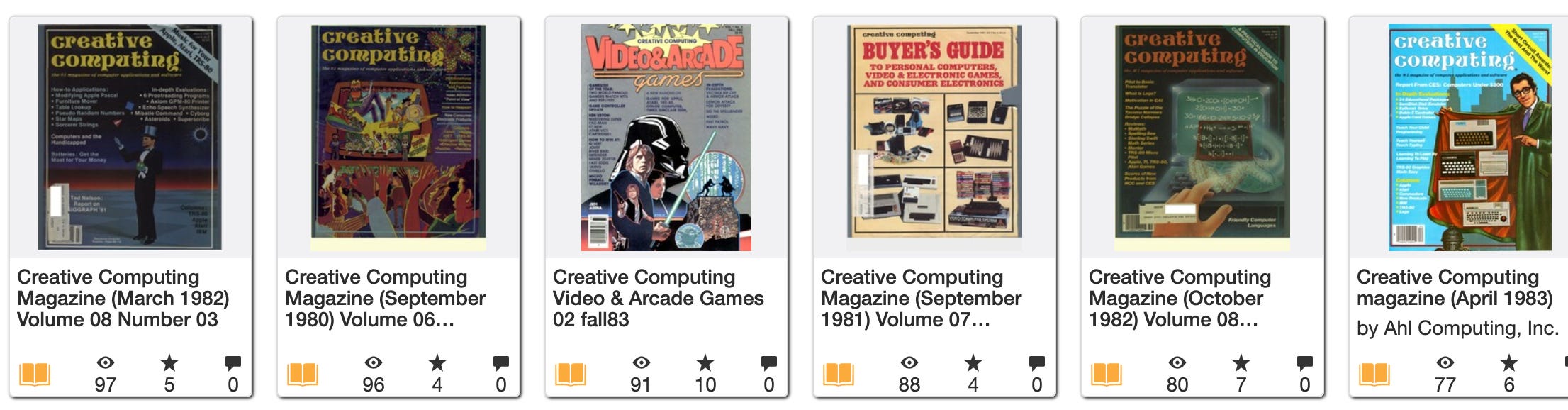
THE VALUE OF THE HUMAN FINGERPRINT
Before generative AI flooded our feeds with frictionless, hyper-polished sameness, artists had to actually wrestle with their medium. That friction left behind weird creative swings, personal touches and authentic, sometimes messy flaws that no prompt can ever truly simulate.
A lot of us are starving for that exact texture. Looking at the raw, manual effort that went into these early covers, it’s wild to see how our relationship with technology has shifted by now. These archives capture a distinct era when computers were strictly tools to amplify human imagination, complete with all its quirks and imperfections.
So, we built machines to remove human error and now we’re asking them to put it back. We're going to keep digging through the archives to make sure the weird and distinctly human side of digital history doesn't get buried by the algorithm.
Cheers,
🛸 The Orbit


Niu Lai is the most talked-about movie I've come across recently. People are curious about it because of how rough it looks and the interesting story behind it. Plus, tickets are only around three bucks, so a lot of people are happy to go check it out in theaters. The film itself isn't good, but just going to see it with friends is fun enough :)
“I no longer know what I’m looking at” — this single phrase exposes the whole flaw of the anti-AI stance. Critics deliberately ignore the difference between looking and seeing, listening and hearing, or reading and actually understanding.
In any utterance, regardless of the medium, the substance is what truly matters: a solid fact or a well-reasoned idea that invites dialogue and leads to conclusions. By reducing all creative value down to manual execution, AI critics completely erase meaning. By that logic, the work of directors, producers, supervisors — everyone who shapes ideas rather than building them by hand — is worthless. Why does it make any sense to anyone?