



Dating-app advertising used to be fairly easy to recognise.
There was usually an attractive stranger, a mildly suggestive line and a strategically placed phone screen showing two people having the most natural conversation ever recorded inside a branded chat bubble.
Every campaign seemed to raid the same dating starter pack: a first date disastrous enough to dominate the group chat, a statistic proving singles had finally discovered feelings and situationship upgraded from slang to a full-blown social condition.
The apps may have sold different versions of romance, but they compressed them into the same tidy sequence:
Like. Match. Message. Meet.
A person became six photographs, three prompts and a carefully selected answer about whether they preferred staying in or going out.
For more than a decade, this was not only how dating apps worked,it was how they imagined love: legible, optimised and always one gesture away. Now, that world is beginning to break open – not necessarily inside the apps, but around them.
The same companies that turned intimacy into an interface are trying to build cultural worlds people might enter even when they aren’t actively looking for a date.
A Brief History of Selling the Meet-Cute
To understand why this shift matters, it helps to look at what dating apps used to sell. Some of their most memorable campaigns gave the same basic interface a different emotional promise: agency, commitment, entertainment or, occasionally, Satan dating the year 2020.
The Ball Was in Her Court
Before Bumble started organising group meetups, it sent Serena Williams to the Super Bowl to tell women to make the first move. Dating-app differentiation still fitted neatly inside a 30-second slogan.
Bumble x Serena Williams, 2019
Designed to Be Deleted
Hinge gave its app icon a furry body and repeatedly killed it whenever two users fell in love. Nothing says romance quite like watching your product mascot get crushed by an air conditioner.Hinge’s original campaign by Red Antler, 2019
Swipe Right at the End of the World
Tinder turned the apocalypse into a choose-your-own-adventure series in which every decision could affect your matches. Even the end of civilisation, apparently, needed a dating mechanic.Satan Meets 2020
Match paired Satan with the year 2020 and soundtracked their romance with Taylor Swift’s re-recorded Love Story. It was less an advert for finding love than a perfect time capsule of a year already beyond parody.
Match’s “Match Made in Hell,” 2020
These campaigns chart the moment dating apps stopped merely explaining their products and started constructing personalities around them. But however inventive the campaign became, it always led back to the same place: the app.
Now the interface itself is the thing people are getting tired of.
Dating Apps Want Out of the App
Dating-app marketing once had one awkward job: convince people that meeting someone online was not a sign that something had gone terribly wrong.
You could say the interface worked almost too well. Apps gave modern dating a new vocabulary—swipe, match, unmatch, ghost—then made living inside it exhausting. Endless choice, constant evaluation and the low-level suspicion that another person is always waiting one thumb movement away.
The growing interest in singles events, group dates and introductions through existing communities is not necessarily a rejection of technology. It is a search for the context that apps removed. Meeting through friends, at a dinner, or inside a running club comes with friction, witnesses and some sense of a shared world.
Dating platforms have noticed, and each is trying to rebuild that missing sense of context in a different way.
Tinder is moving towards entertainment, wrapping modern dating in Bridgerton-style fantasy and turning romantic yearning into its own campaign universe. Bumble is moving in a more literal direction, experimenting with low-pressure group meetups and imagining a future in which meeting through the app might eventually mean leaving the swipe behind.
Hinge has taken a third route: publishing.
These responses may look unrelated, but they address the same problem. Rather than promising a better interface, dating apps are borrowing from the wider culture surrounding romance—television, live events, book clubs and literature—to make dating feel social, immersive and meaningful again.
There is an obvious contradiction in apps helping people escape app-shaped dating.
That contradiction is also what makes Hinge’s approach so interesting.
When a Dating App Acts Like a Publisher
Most dating apps would answer swipe fatigue with a new feature. Hinge answered with five authors, a harpsichord and a love story told from the perspective of a cat.
This unusual combination is the brainchild of No Ordinary Love, Hinge’s ongoing anthology based on real couples, which is now available as an audiobook for the first time. It was first published in 2024 as a printed and digital anthology about the imperfect beginnings of real relationships. Three editions later, the project has involved sixteen contemporary authors and expanded from digital stories into physical publishing, as well as venturing into the realms of Substack, audio, film, illustration, music and out-of-home advertising.


Tembe Denton-Hurst, Raven Smith, Rufi Thorpe, Nicola Dinan and Curtis Garner were each paired with a couple who met on Hinge. They turned the awkward conversations, misread signals and emotional risks from the early stages of those relationships into short stories, which they then narrated themselves. Hunter Harris provides the foreword; the real couples return for the epilogues.
We first came across the project here on Substack, but the written stories are only one part of it. Together with Dazed Studio, Hinge has packed medieval illustrations, ’90s rom-com references, a harpsichord score, tattoos and trailers starring the couples themselves into the same campaign.
It is a lot. It is also the kind of creative sprawl that makes “dating-app advertising” feel like an increasingly inadequate description. The result sits somewhere between Modern Love, an audiobook imprint and a lavishly art-directed ad.
Audio also changes the emotional texture of the stories. A screen can show us what somebody typed; a voice gives away the pause before they say it. That distinction matters in a project built around people admitting something before they know how it will be received.
The Authors are Not Just Copywriters
The names give the project literary credibility; the stranger creative decisions give it life. Rufi Thorpe tells one couple’s story through the eyes of their cat—which is frankly one of the more credible narrators available when humans attempt to date.
The pairings give the project literary weight, but they also create one of its most delicate questions: What happens when a brand, an agency, a writer and a real couple all have a claim on the same story?
Each author narrates their own story. A couple shares its history. A writer interprets it. The writer then performs that version aloud. Finally, the couples return in the epilogue to reflect on the relationships behind the stories.
The result sits somewhere between Modern Love, an audiobook imprint and a lavishly art-directed ad.
Audio also changes the emotional texture of the stories. A screen can show us what somebody typed; a voice gives away the pause before they say it. That distinction matters in a project built around people admitting something before they know how it will be received.
In other words, the audience is listening to more romance while simultaneously struggling to share what it wants.
Finding No Ordinary Love on Substack made the project feel unusually close to home. As fellow Substackers, we were curious not only about what Hinge was publishing, but what it meant for a dating app to enter a space built around direct relationships between writers and readers.
Where does publishing end and advertising begin? At what point does a campaign stop behaving like a campaign and start operating more like an editorial platform?
There is an obvious tension here. Hinge benefits from the emotional landscape it is documenting—a dating culture shaped by profiles, prompts, notifications and the constant awareness that somebody else might always be one swipe away.
A dating app encouraging people to reject dating-app behaviour is complicated. But that complication is precisely what makes the project worth examining.

“Authenticity” has become one of advertising’s most carefully manufactured products. Brands know audiences are suspicious of perfection, so imperfection is now produced with professional precision. The photograph is blurry, but intentionally blurry. The confession is vulnerable, but safely contained. The story is messy, but only in ways that lead back to the correct conclusion.
No Ordinary Love works best when it resists that instinct. Its strongest material is not the fact that these couples eventually built relationships, but the uncertainty that came first: the possibility of rejection, the misread intentions and the conversations that began before either person knew what they wanted to say.
In an interview with Inc., Hinge described these moments as emotional “micro-risks”—small acts of directness that can help establish trust. None of the stories depends on a grand romantic declaration.
The risk is sending the text. Asking the question. Admitting something before knowing whether the other person wants to hear it.
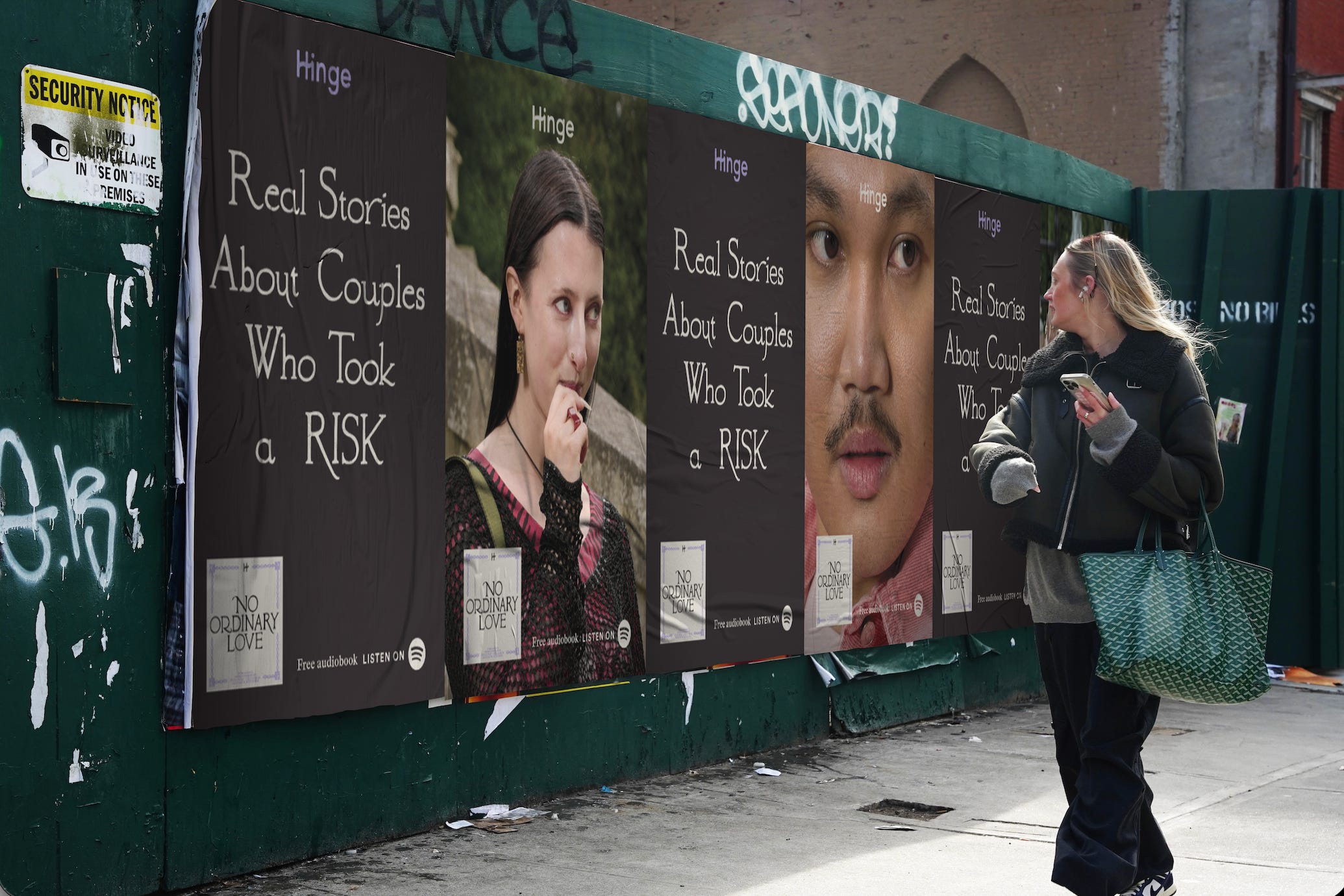
We did what Substackers do when curiosity gets the better of us: sent Hinge a slightly overcommitted list of questions about authorship, advertising and who gets to shape a real couple’s story.
Hinge came back with detailed answers from Ola Sobiecki, its VP and Executive Creative Director. Asked whether No Ordinary Love had always been intended to grow beyond a one-off campaign, they told us:
“At Hinge, we’re much more interested in building worlds that can keep evolving. Each edition lets us explore a new literary medium, and also a new theme that feels relevant to dating culture at that moment—from the pressure to be perfect to the two sides of every love story. This year, we explored the emotional risk of actually telling someone how you feel.”
The Swipe Was Never the Story
Look past Hinge and the project reveals a broader shift in how dating platforms are responding to everything their interfaces left out.Dating apps made attraction searchable and introductions scalable. But they also removed much of the context through which people once made sense of one another.
A profile can tell you that somebody likes natural wine, Sunday walks and The Sopranos. It cannot recreate the feeling of meeting through friends, talking at a dinner or repeatedly noticing the same person at a run club.
The growing interest in singles events, group dates and offline communities is not necessarily a rejection of technology. It reflects a desire for connection that feels less like evaluating a profile and more like participating in a shared world. That same longing helps explain why dating platforms are moving into publishing, entertainment and live experiences. They are no longer competing only over who can arrange the introduction. They are competing over who can make that introduction feel meaningful.
Dating apps helped compress intimacy into an interface. Now they are discovering that people want a shared world around it.
Next week, we’ll publish our complete conversation with Ola Sobiecki—on creative freedom, emotional honesty and what happened when Rufi Thorpe let a cat hijack the narrative.
Catch you next time,
Sarah