


Hello!
We’re back with your monthly dose of the bizarre and delightful in creative culture, design oddities and internet curiosities. Grab a coffee, or whatever fuels your creative weirdness and dive in!
In this issue:
Brand strategy shifts: Vaseline (social listening), IKEA (everyday storytelling), Sprite (sensory branding)
“2026 = 2016” nostalgia loop and the return of old internet trends
Curated internet finds: oddities, visuals, and creative inspiration
Pop culture artifacts and digital aesthetics worth watching
A mix of marketing insight + chaotic online culture signals

🌟 Fresh Orbit: Creative News & Quick Takes
A significant technical milestone was reached on March 16, 2026, with the unveiling of NVIDIA DLSS 5. Described as the “GPT moment for graphics,” this real-time neural rendering model infuses pixels with photoreal lighting and materials, bridging the gap between rendered environments and reality.
Unilever’s Vaseline shows how modern marketing is shifting toward real-time “social listening.” Instead of relying on influencers, the brand watches TikTok trends and responds by validating user hacks with expert input—turning a 150-year-old product into something that feels current and culturally engaged.
Similarly, IKEA’s “Everyday Life” campaign avoids price-led messaging and focuses on how products fit into real life. By highlighting simple materials and everyday moments, it shows that relatable storytelling—not scale or spend—is what builds brand connection today.
Sprite’s “It’s That Fresh” rebrand (March 2026) shows how sensory branding can sharpen differentiation. The update brings back the “Lymon” lemon-lime symbol, adds a new sonic identity, and uses bolder colors and vertical typography to make the drink feel crisp before it’s even opened. The goal is simple: make Sprite instantly recognizable across sight and sound.
The phrase “2026 is the New 2016” has taken off online, driven by Gen Z revisiting a 10-year nostalgia cycle. On platforms like TikTok, users are recreating viral moments like the Bottle Flip, Mannequin Challenge, and the peak of Pokémon Go. The trend reflects a kind of “meme reset,” where familiar formats return with minimal updates.
Google shipped a massive update to Stitch on March 18–19, transforming its free AI design tool into an AI-native infinite canvas with voice interaction (”vibe design”), instant prototyping, and MCP server integration. Figma’s stock dropped ~12% over two days following the announcement.
GF Smith’s radical rebrand by London studio Templo was cited as a standout example of 2026’s identity design shift from “sans-serif sameness” to logos with personality. Industry experts noted logos in 2026 are “remembering they can smile.”
Canva declared 2026 the “Year of Imperfect by Design” in its annual trends forecast based on insights from 260 million creators, emphasizing raw authenticity, tactile textures, and creators bending AI to personal style.
Sagrada Familia in Barcelona approaches completion in 2026, the 100th anniversary of Antoni Gaudí’s death. After 144 years of construction, the basilica is nearing architectural completion, though decorative work will stretch into the 2030s.
Ogilvy and IBM ended their legendary 32-year creative partnership (reported March 19–20). WPP’s Ogilvy chose not to participate in IBM’s upcoming creative RFP, ending a relationship that began in 1994 with a landmark $500M account consolidation.
Anthropic’s Super Bowl ads mocking ChatGPT advertising were the most talked-about AI play of Q1. The “Ads are coming to AI. But not to Claude” campaign drove Claude’s app from #41 to #7 on the App Store, with a 32% download increase.
HelloFresh staged a giant transparent delivery box at London’s Waterloo Station, using a PixelGlass countdown during the day before revealing a real family cooking dinner inside by evening. The brand also opened “The No-Need-To-Go-To-The-Store Store” at Antwerp Central Station in Belgium.
The 98th Academy Awards took place on March 15, hosted by Conan O’Brien for the second consecutive year. One Battle After Another (directed by Paul Thomas Anderson) won six Oscars including Best Picture, Best Director, and Best Adapted Screenplay — marking PTA’s first-ever Oscar wins.
Michael B. Jordan won Best Actor for Sinners and Jessie Buckley won Best Actress for Hamnet at the Oscars. Sean Penn won Best Supporting Actor for One Battle After Another but was not present at the ceremony.
**Reuters published an investigation on March 13 claiming to have definitively identified Banksy as Robin Gunningham**, 51, from Bristol, based on a handwritten confession from a 2000 arrest in New York. The investigation found he legally changed his name to David Jones.
A San Francisco jury found Elon Musk liable for misleading shareholders with two tweets during his 2022 Twitter acquisition March 20), awarding approximately $2.1–2.6 billion in damages. Musk’s lawyers called it “a bump in the road.” 👀
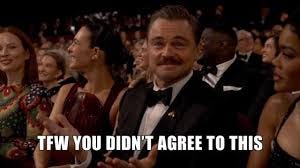
The 2026 Oscars spawned a new viral meme: Leonardo DiCaprio’s “tfw you didn’t agree to this” reaction image from the ceremony became the internet’s newest format.

🔗 Curated Links: Oddities & Inspirations
Click a button and you’re suddenly looking out of someone else’s window somewhere in the world. No algorithm, no feed. Just ambient life.
A button that sends you to a random pointless website. No goal, no logic, just pure internet wandering.
Mash your keyboard and instantly look like you’re in a 2000s hacker movie.
RGB stands for red, green, and blue. If you hover over each letter, the background will change to the respective color while a robotic voice pronounces the letter out loud.
A 1997 internet artwork that feels like getting lost inside someone’s brain tabs. No navigation, just vibes. It’s messy, nonlinear, and still more interesting than most “clean UX” today.


❓ Questions No One Asked (But We Answered Anyway)
Why did early 2000s toothbrushes look like alien battle tech?
The short answer: shelf-war marketing, fake science, and a collective obsession with looking like the future.
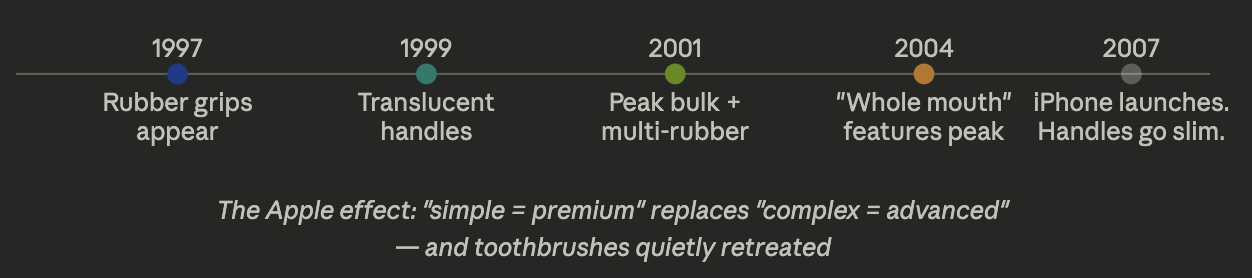
By the late ‘90s, Oral-B and Colgate were in a bitter fight against $1 generics. The solution was to add stuff—angled necks, tongue scrapers, rubber grips—and make the handle scream engineered. Like a Sharper Image catalogue item, except you left it on the bathroom sink for three months. Some of the ergonomics were real, but most were theater. The lumpy handles and multicolored zones weren’t built for grip, they were styled to look like they were. Meanwhile, everything in 1999–2003 looked like this anyway—the iMac G3 was translucent, the Reebok Instapump looked like a moon boot, your toothbrush wanted to feel like the bridge of the Enterprise.
The final push came from electric toothbrushes. Once Sonicare hit shelves, manual brushes panicked and tried to look like they also had a motor inside. Hence the fake vents and chunky bodies implying internal mechanism. It peaked around 2002–2004. Then the iPhone happened, Jony Ive made everyone feel bad about rubber nubs, and toothbrushes quietly went on a diet.


Here is a very important timeline for you:
🎟 Pop-Culture Artifact of the Month
WatchMeForever – A live, never-ending AI-generated sitcom


WatchMeForever is a 24/7 AI-generated sitcom that’s been streaming on Twitch since December 2022, built by the studio Mismatch Media. It writes itself in real time, using models like GPT-3 inside a low-poly, Unity-built apartment that looks like a lost PS1 game.
It started as a Seinfeld-like setup: four characters, a couch, conversations about nothing. But instead of scripts or episodes, everything is generated on the fly. Awkward pauses, broken punchlines, and conversations that almost make sense before drifting off completely. At its peak in early 2023, thousands of people were watching at the same time; not because it was good, but because it was uncanny. Familiar enough to recognize, broken enough to feel new.
The first version, Nothing, Forever was briefly suspended in early February 2023, after the AI produced transphobic jokes about transgender people, including lines that framed being transgender as a “mental illness” and questioned gender identity in a mocking way. This wasn’t scripted or intended by the creators; it was generated live by the language model.
That clip spread quickly, and within hours Twitch suspended the channel for violating its hate speech policies. The stream was taken offline for about two weeks.
After that moment, the project quietly shifted: it dropped the explicit Seinfeld parody, renamed from Nothing, Forever to WatchMeForever, and reworked its characters and format. The reason wasn’t aesthetic; it was legal. The original version leaned heavily on recognizable sitcom structures and character archetypes, raising copyright concerns. The reboot kept the infinite AI format, but removed direct references, turning it from a parody into something more abstract and… arguably even stranger.
It’s still running as a kind of ambient television experiment: Something you don’t follow, just leave on. Not a show, really. More like watching the idea of TV slowly glitch in public.
Thanks for reading!
Forward this newsletter to your favorite design-nerd friends, internet nostalgics, and lovers of all things odd. See you next month—stay curious!
🛸 – The Orbit Team
